
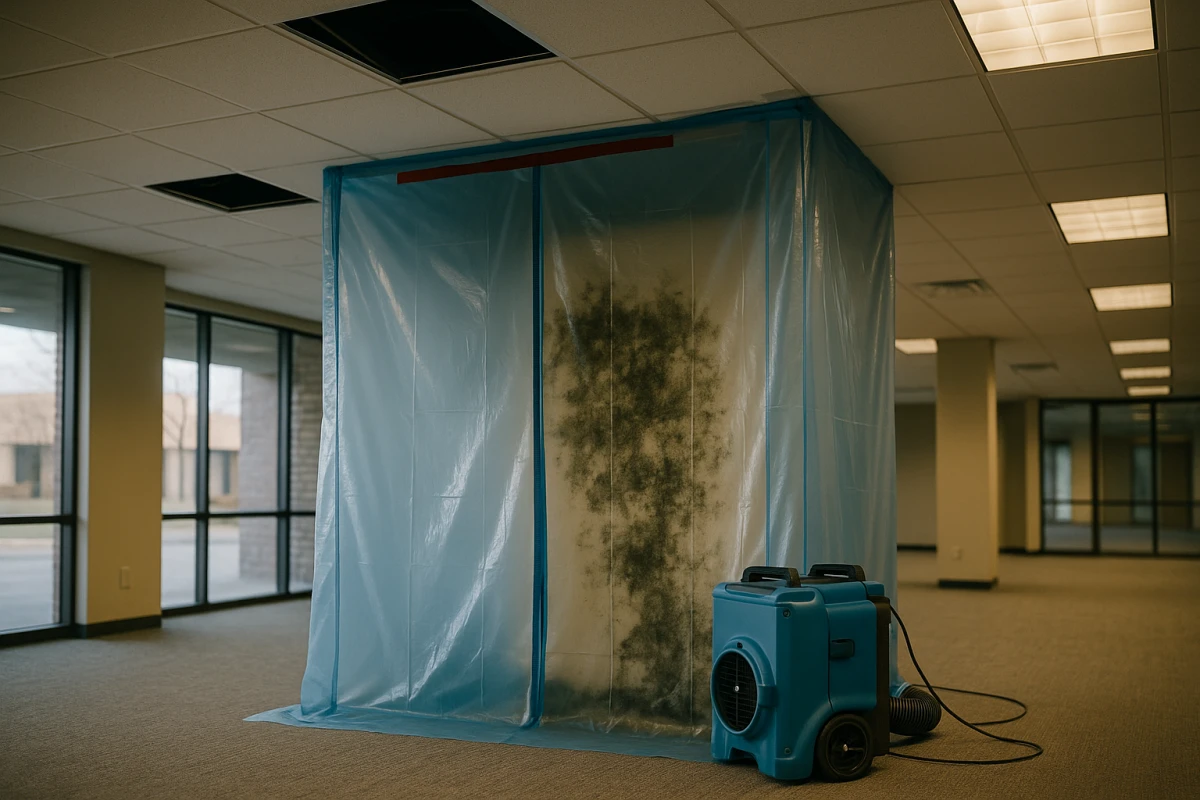
For a Katy business, mold is two problems at once: a health-and-liability issue and a continuity issue. Customers and employees notice a musty smell, a stained ceiling tile, or a closed-off area, and every day a space sits unusable costs money. Commercial remediation has to move fast, work around occupancy, document everything for landlords and insurers, and meet a higher bar for air quality — especially in medical, food-service, childcare, and rental settings. The licensed commercial pros we connect you with are set up for exactly that.
Where commercial mold shows up in Katy
- Flat and low-slope roofs: common on strip retail and office buildings; ponding and leaks feed mold above the ceiling grid.
- Rooftop and packaged HVAC units: large systems that, like home AC, condense and distribute spores across an open floor plan.
- Restrooms and break rooms: high-use plumbing and humidity in spaces that don't always get fast leak repairs.
- Storage and back-of-house: low-traffic areas where a slow leak goes unnoticed for months.
- Tenant build-outs: sealed-up spaces and trapped construction moisture.
What makes commercial different
The remediation science is the same — contain, remove, dry, verify — but the constraints are tougher. Commercial work is often scheduled after hours or in phases to keep the business open. It involves drop ceilings, larger HVAC, and sometimes specialized materials. And the documentation matters more: building owners, property managers, insurers, and sometimes tenants all need a clear record of what was found, what was done, and proof the air is clear.
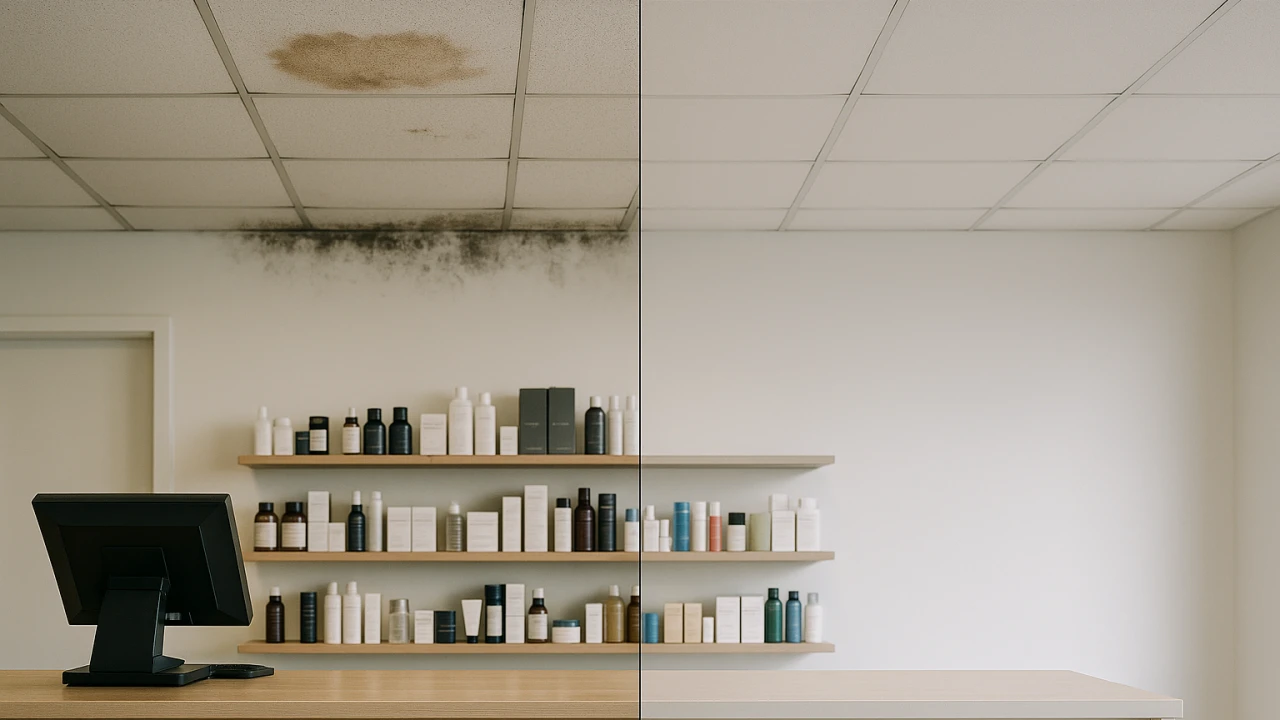
Industries we help coordinate
- Retail, restaurants, and strip-center tenants along the I-10 and Grand Parkway corridors
- Offices and medical or dental suites where air quality is critical
- Childcare and schools, where sensitivity and documentation are paramount
- Multi-family and apartment communities managing tenant units
- Warehouses, light industrial, and self-storage facilities
The commercial remediation process
- Assessment & plan. Inspection, moisture mapping, and a written protocol with a timeline that fits your operations.
- Containment around occupancy. Affected zones are sealed and put under negative air so the rest of the building keeps running.
- Removal & drying. Contaminated ceiling tile, drywall, and materials are removed; commercial drying equipment handles the structure.
- HVAC coordination. Rooftop and packaged units are evaluated so the building's air handling doesn't spread spores.
- Clearance & documentation. Third-party testing and a complete report for owners, insurers, and tenants.
Minimizing downtime
The goal is always to keep you operating. Phased scheduling, after-hours work, and tight containment let most Katy businesses stay partially or fully open during remediation. The faster the assessment happens, the more options there are to work around your hours — another reason not to wait once you spot a problem.
Cost and documentation
Commercial pricing depends on square footage, materials, after-hours scheduling, and HVAC scope. Thorough documentation is part of the value — it supports insurance claims and protects against liability. Get a free commercial assessment and review our cost guide.
Frequently asked questions
Can you remediate without closing my business?
Usually, at least partially. With proper containment and negative air, affected zones are sealed off while the rest of the space operates. Many commercial jobs are scheduled after hours or in phases specifically to avoid a full shutdown.
Who is responsible for mold in a leased space — landlord or tenant?
It depends on the lease and the cause. Structural and roof issues typically fall to the landlord; tenant-caused moisture may fall to the tenant. A documented third-party assessment of the source helps resolve responsibility fairly. Review your lease and consider professional advice.
Do we need clearance testing for a commercial space?
For most commercial settings — and especially medical, food-service, and childcare — yes. Independent post-remediation testing documents that the air is back to normal, which protects you with insurers, tenants, and any future occupant.
How quickly can a commercial assessment happen?
Often within a day or two for the initial inspection. Fast assessment matters: it gives you more scheduling flexibility to work around operating hours and limits how far the problem spreads.